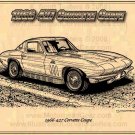
Here's the story on this print:
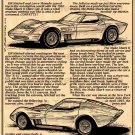
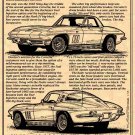
Illustrated Corvette Series No. 151 - "Frank Winchell's Mid-Engine Corvettes"
In the summer of 2009, the Corvette blogosphere was abuzz with speculation about a possible C7 Corvette. GM’s much-publicized financial challenges had many Corvette fans pondering the fate of the iconic sports car. In a chat-room Q&A with GM CEO Fritz Henderson, I asked if and when we might see a C7. His response was that product planners had a lot of exciting things in the works for the car. Since the 1960s, speculation about the “next” Corvette has always led to a discussion of a mid-engine configuration. Back in the ‘60s, weight distribution and traction were the major advantage of such a drivetrain layout. But thanks to undreamed-of advances in tires and suspension controls, the disadvantages of a mid-engine placement now far outweigh the advantages.
When it comes to early Corvette history, men such as Bill Mitchell, Ed Cole, and Zora Arkus-Duntov cast very long shadows over the storyline. While these and other men definitely steered the overall direction of the Corvette toward their own visions, they did not design every aspect of the car. While Duntov got the lion’s share of attention for pushing the mid-engine effort, there was another power player who was all but invisible to the public: Chevrolet Chief of Engineering Frank Winchell. Many inside GM and Chevrolet wanted to design Corvettes, but Winchell had some unusual design perspectives.
Unlike Duntov, Winchell was comfortable being a low-profile corporate man. He felt he could get more done that way. Those who worked with both men said that while Duntov managed with love and enthusiasm, nobody worked “with” Winchell; they worked “for” him. While Duntov and Winchell respected each other, they often locked horns over design concepts. Winchell guided the designs of three unique mid-engine concept Corvettes, which we’ll cover here.
While GM did not officially race cars, the company did manage a backdoor system for assisting select racers. Jim Hall of Chaparral Cars ran one of these unofficial road-racing outfits. The first joint effort between the two produced a slick-looking car that unfortunately had lots of front-end lift. Their second effort produced a car with a much more nose-down attitude; it was called the Corvette GS-II. The initial version was build on a thin-gauge steel monocoque chassis. Once the basic design was worked out, an aluminum version was created with an ultra-thin fiberglass body, a small-block Chevy engine, and an automatic transmission. The total weight was just 1,450-pounds, and the car had a top speed of 198 mph.
Hall used the basic design as a platform for his Chaparral race cars. Many were suspicious of the aluminum chassis, but Hall called it “an eyeball jiggler” because it was so rigid. After a GS-IIb version was created, work on the project ended.
Winchell’s next shot at a mid-engine car came as a result of an argument with Duntov. Winchell contended that if you put an aluminum engine behind the rear axle, and added the correct oversized rear tires and suspension, the car would offer superior handling. Duntov disagreed. After the basic locations of the car’s major components were established, Larry Shinoda was brought in to “make it look pretty.” Considering that Shinoda had to cover a small-block engine hanging off the rear axle, the car didn’t look bad, and a prototype was built. The running car handled great—up to the tires’ breaking point, when it would oversteer wildly. The car ultimately crashed in testing when production-size tires were tried on a wet track. After the wreck, the pieces were sent to Smokey Yunick’s shop to be used as a starting point for a new race car he wanted to build (but never did). The pile of scrap was later discovered by some Corvette enthusiasts who recognized with it had once been. They bought the basket case and refurbished it with a cast-iron small-block Chevy. Reportedly, it does excellent wheelies!
By ‘68 mid-engine mania had gripped Ford and even American Motors. When Chevrolet officials learned that Ford was developing the Mach II mid-engine Mustang, they had to do something. Of all the mid-engine Corvette concepts Winchell dreamed up, the XP-880 was the closest to a production design yet. This time, an L36 427 was placed ahead of the rear axle and turned 180 degrees so the accessory parts would hang off the back of the engine. A steel backbone frame was created, with fuel tanks placed inside the center backbone. To make the car more realistic from a production standpoint, suspension and brake components were off-the-shelf Camaro and Corvette pieces. The two-speed automatic transaxle—sourced from a ’63 Tempest—was a glaring weak point. Stylists did a great job of making the XP-880 look like a Corvette. The roof looked like the new C3, and the front and rear fender humps definitely said “Corvette.” Initial track testing proved that the design had real potential. This time, Winchell got it right.
The car was painted Fire Frost Blue, dressed up with “Astro II” badges, and sent off to the ‘68 New York International Car Show. Many said that the XP-880 seriously upstaged the Mach II. Ultimately, the concept was rejected for two reasons. First, tooling costs would have added too much to the sales price. And second, the new C3 was selling just fine. It wasn’t broke, so Chevrolet wasn’t about to fix it.
_________________________________________________________________________________________________________________________________________________
Printed on high quality tan-colored parchment paper using a Xante professional grade printer.
This print comes in one size:
11” x 17”
Print is shrink wrapped on 11.5" x 17.5" cardboard so that they stay flat and clean and shipped via USPS Priority Mail. All prints are signed by the artist. They make a wonderful gift for the car lover in your life!