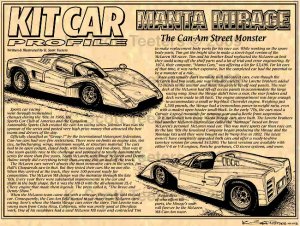
Manta Mirage - "Can-Am Street Monster" - Sports car racing went through tremendous changes during the ‘60s. In 1966, the Sports Car Club of America and the Canadian Automobile Sports Club created the can-Am racing series. Johnson Wax was the sponsor of the series and posted very high prize money that attracted the best teams and drivers of the day.
Officially classified as “Group 7” by the International Motorsport federation, Can-Am cars had very few restrictions. There were no limits on engine size, tire size, turbocharging, wings, minimum weight, or structure material. The cars had to be open cockpit, closed body, with two seats and two doors. That was it! One team quickly rose to the challenge and proceeded to totally dominate the series for more than five years. Team McLaren, with Bruce McLaren and Denny Hulme simply did everything better than anyone else on and off the track.
The McLaren cars weren’t always the most innovative cars in the series, Jim Hall’s Chaparrals saw to that. But they tested their cars like no one else. When they arrived at the track, they were 100-percent ready for competition. The McLaren M8 design was the mainstay through the late ‘60s. Every year there were substantial improvements in the car and slight in the body shape. But it was the M8-D with the all-aluminum ZL-1 Chevy engine that made them legends. The press called it, “The Bruce and Denny Show.”
When the McLaren team came out with a new car, they usually sold the old car. Consequently, the Can-Am field started to see many more McLaren cars racing. here’s where the Manta Mirage cars enter the story. Tim Lovette was a young man from Costa Mesa, California, who was pretty good at fiberglass work. One of his neighbors had a used McLaren M8 racer and contracted Tim to make replacement body parts for his race car. While working on the spare body parts, Tim got the bright idea to make a street-legal version of the McLaren M8 racer. Tim and his brother Brad replicated the McLaren as best they could using off the shelf parts and a lot of trial and error engineering. By 1974, their company, “Manta Cars,” was offering a kit for $3,498. For kit cars of that time, it was rather expensive, but the completed car had the potential to be a monster of a ride.
Race cars usually don’t translate well into street cars. even though the McLaren had two seats, one was virtually useless. The Lovette brothers added 12-inches to the interior and made targa-style lift-off roof panels. The rear deck of the McLaren had lift-off access panels to accommodate the large racing wing. Since the Mirage didn’t have a rear, the rear fenders and deck were made to tilt back. The engine compartment was large enough to accommodate a small or big-block Chevrolet engine. Weighing just 1,500 pounds, the Mirage had a tremendous power-to-weight ratio, even with a modest open header small-block. In the early ‘70s, the cars used a Corvair 4-speed transaxle for running gear and a Beetle front suspension.
It is not known how many Manta Mirage cars were built. The Lovette brothers had another McLaren-inspired car called the “Montage” based on Bruce McLaren’s personal McLaren road car. This was more sports car than race car. By the late ‘80s the Kneeland Company began producing the Mirage and the Montage kits until they were bought out by Warp Five in 1992. The latest owners have completely upgraded both cars and offer a ready-to-drive turn-key version for around $43,000. The latest versions are available with either V-6 or V-8 engines, Porsche gearboxes, CD stereo systems, and more.
Regardless of who offers the parts, the Mirage’s soul will forever be the McLaren M8 Can-Am racer.
Printed on high quality tan-colored parchment paper using a Xante professional grade printer.
This print comes in one size:
11” x 17”
Print is shrink wrapped on 11.5" x 17.5" cardboard so that they stay flat and clean and shipped via USPS Priority Mail. All prints are signed by the artist. They make a wonderful gift for the car lover in your life!