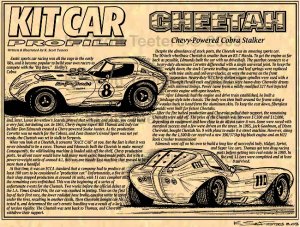
Cheetah Road Racer - "Chevy-Powered Cobra Stalker" - Exotic sports car racing was all the rage in the early '60s, and it became popular to build your own racers to compete with the "Big Boys." Shelby's Cobra and, later, Lance Reventlow's Scarab, proved that with guts and pizzaz, you could build a very fast, hot-looking car. In 1963, Chevy engine expert Bill Thomas and Indy car builder Don Edmunds created a Chevy-powered Snake hunter. As the production Corvette was no match for the Cobras, and Zora Duntov's Grand Sport was not yet ready, the Cheetah was set to stalk to Serpents.
When you look at a Cheetah, it screams "RACE CAR" at you. But the fact is that it was never intended to be a racer. Thomas and Edmunds built the Cheetah to make money! Consequently, the wild-looking machine is loaded with off-the-shelf, Chevy production parts. An all-out racer would have had many more exotic hand-made parts. But with a power-to-weight ratio of around 4:1, this was one bloody fast machine that proved to be more than a handful.
At that time, it was an SCCA standard that a company had to produce at least 100 cars to be considered a "production car." Unfortunately, a fire in their shop stopped production at around 16 units, with 11 cars complete and the remaining cars unfinished. This was the beginning of a series of unfortunate events for the Cheetah. Two weeks before the official debut at the L.A. Times Grand Prix, the car was crashed in testing. Then on the first lap of their first race, the lower radiator hose broke, causing water to spray under the tires, resulting in another crash. Then Chevrolet bought car No. 1, tested it, and determined the car's erratic handling was a result of a lack of torsion rigidity. The Cheetah was sent back to Thomas, and Chevrolet withdrew their support.
Despite the abundance of stock parts, the Cheetah was an amazing sports car. The 90-inch wheelbase Cheetah is smaller than an RX-7 Mazda. To get the engine as far back as possible, Edmunds built the car with no driveshaft. The gearbox connects to a heavy-duty aluminum Corvette differential with a single universal joint. To keep the weight down, the stock Corvette trailing arms and leaf springs were replaced with tube units and coil-over-shocks, as were the a-arms on the front suspension. Heavy-duty '62 Chevy station wagon spindles were used with a Triumph Herald rack and pinion. Brakes were heavy-duty Chevrolet drums with sintered linings. Power came from a mildly modified 327 Fuel Injected Corvette engine with open headers.
After Edmunds had the engine and drive train established, he built a birdcage-style tube chassis. The body was then built around the frame using a wooden buck to hand-form the aluminum skin. To keep the cost down, fiberglass molds were built for future Cheetahs.
After the fire halted production and Chevrolet pulled their support, the remaining Cheetahs were sold off. The price of the Cheetah was between $7,500 and $12,000, depending on equipment and how close to an all-out racer it was. Some were raced with marginal success and a few were driven on the street. In 1965, Jack Goodman, of Dixon Chevrolet, bought Cheetah No. 9 with plans to make it a street machine. However, along the way the the 1,500-lb car received a new 396/375hp big-block engine and an M22 Rock Crusher transmission!
Edmunds went off on his own to build a long line of successful Indy, Midget, Sprint, and Super Vee cars. Thomas got into drag racing parts before getting into real estate in 1969. In the end, 11 cars were completed and at least 8 survived.
Printed on high quality tan-colored parchment paper using a Xante professional grade printer.
This print comes in one size:
11” x 17”
Print is shrink wrapped on 11.5" x 17.5" cardboard so that they stay flat and clean and shipped via USPS Priority Mail. All prints are signed by the artist. They make a wonderful gift for the car lover in your life!